A home that looks cheaper in the first meeting can feel considerably more expensive after the second calculation. Add GST, stamp duty, registration, parking, maintenance deposits, brokerage, and interiors to a new-construction purchase, and the gap between “new” and “resale” often narrows or reverses entirely from what the base prices first suggested. On an ₹1.5 crore luxury flat booked under construction, GST alone adds ₹7.5 lakh straight to the government, money that adds zero value to your actual asset, and buying the same property resale removes that cost entirely. Understanding exactly where each option genuinely wins requires running the full numbers, not just comparing headline prices.
The Core Definitions
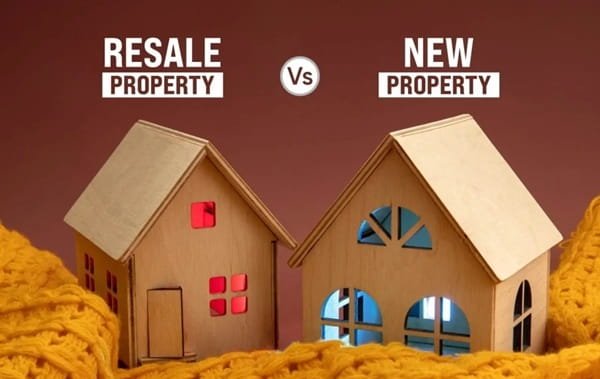
Before comparing costs, it’s worth being precise about what actually separates these two transaction types, since the distinction shapes everything that follows.
- A new property is purchased directly from a builder or developer, either under construction or freshly completed, while a resale property is purchased from an existing individual owner.
- The transaction structure differs fundamentally: buying new typically involves a builder-buyer agreement with staged payments, while resale involves a direct sale deed transfer between two private parties.
- Buyers in 2026 increasingly compare the two across possession timelines, GST impact, maintenance costs, appreciation potential, and location certainty, rather than defaulting automatically to whichever option feels more familiar.
The GST Difference — A Genuinely Major Cost Factor
Tax treatment is the single sharpest dividing line between these two purchase types, and it’s a cost many first-time buyers only discover well into their search.
- New under-construction properties attract 5% GST on non-affordable housing and 1% GST on affordable housing (units priced up to ₹45 lakh with carpet area under 60 square metres), neither with input tax credit passed to the buyer.
- Resale properties are entirely exempt from GST, since the government does not treat a resale transaction as a supply of services, the property is considered already completed, and the sale simply transfers ownership between two individuals.
- New ready-to-move flats with a valid Occupancy or Completion Certificate also avoid GST entirely, since only genuinely under-construction properties without that certificate attract the tax, meaning “new” and “GST-liable” aren’t automatically the same thing.
- On an ₹1.5 crore property, this GST difference works out to roughly ₹7.5 lakh, a substantial saving that both resale buyers and ready-to-move new buyers bypass entirely.
Stamp Duty Applies Regardless of Which You Choose
While GST creates a clear divide, one major cost stays identical no matter which path you take, and it’s important not to mistake GST exemption for total tax exemption.
- Regardless of whether you buy new or resale, stamp duty and registration charges remain mandatory, generally 5-7% of property value depending on the state, applied on whichever is higher, the market value or the actual transaction value.
- Stamp duty and GST are entirely separate taxes with no set-off or adjustment between them, one is a state-level tax on the transaction document, the other a central tax on the construction service, meaning a resale buyer genuinely escapes only the GST portion, not stamp duty.
- The genuinely useful comparison method: add GST to the new construction price and compare that total against the resale price including stamp duty and registration for both, then factor in any rental income lost during a construction waiting period to get a realistic full picture.
Negotiation Room — A Genuine Advantage for Resale Buyers
Price flexibility is one of the more overlooked differences between these two transaction types, and it can matter as much as the tax treatment itself.
- New launches from developers typically come with fixed pricing and limited negotiation room, since builders are selling standardized units at scale and rarely deviate significantly from listed rates.
- Resale sellers are individuals with their own specific motivations and timelines, according to Square Yards analyst Chinmay Gaur, and a genuinely motivated seller can sometimes be negotiated well below their initial asking price, something structurally much harder to achieve with a builder.
- This flexibility means the “discount” a resale buyer negotiates directly can sometimes rival or exceed the base-price advantage a new-construction buyer gets automatically through early booking.
Possession Timeline and Immediate Usability
How quickly you can actually move in, or start earning rental income, is where the practical, day-to-day difference between these two options becomes most obvious.
- Resale properties, being completed, offer immediate possession, letting buyers move in or start earning rental income right away without any construction wait.
- New under-construction properties require waiting, often years, for possession, during which buyers may need to pay both rent for their current housing and pre-EMI interest on the disbursed loan portion simultaneously.
- Many buyers in 2026 now specifically prefer completed or near-completion projects precisely to reduce possession delay risk and avoid this double financial burden of rent plus EMI running concurrently.
Appreciation Potential — Where the Real Nuance Lies
Growth potential is often the deciding factor buyers focus on most, yet it’s also the area where the “new versus resale” framing can be genuinely misleading.
- New properties in growth corridors, like the Dwarka Expressway in Gurugram or Ring Road zones in Lucknow, often offer higher appreciation potential, since you’re buying before an area’s infrastructure and demand fully mature.
- Resale properties in established areas, like Bandra in Mumbai or Dwarka in Delhi, usually provide immediate value clarity, since the neighbourhood, infrastructure, and market pricing are already fully formed and verifiable.
- In most active Indian markets, new-launch and resale prices in the same locality tend to converge by the time construction completes, since the construction-period appreciation on the new unit eventually meets the market rate resale units have already been tracking, meaning the pre-launch buyer’s genuine advantage is specifically the capital gain captured between booking and possession.
Upfront Capital and Financing Differences
Cash flow requirements differ meaningfully between the two, and this often determines which option is actually accessible to a given buyer, regardless of which they’d prefer.
- New bookings often come with flexible, construction-linked payment plans (like 20:80 schemes), letting buyers pay progressively as the building advances, easing cash flow considerably compared to a lump-sum requirement.
- Resale purchases typically require a considerably higher upfront down payment, often 20-30% of the property value, since the full transaction usually needs to close faster.
- Banks may also value older resale properties lower than the seller’s asking price, sometimes sanctioning a loan for only 60-70% of the actual cost, forcing buyers to fund the remaining gap from their own resources, a genuine financing constraint new-property buyers with developer-approved projects don’t face as acutely.
Legal Certainty and Due Diligence
The verification burden looks different depending on which type of property you’re buying, and neither option lets you skip this step entirely.
- Resale transactions generally involve fewer construction-related complexities, since the property is already completed, registered, and has an established ownership history, but buyers must still verify the encumbrance certificate to confirm no pending dues or legal disputes exist.
- New property purchases benefit from RERA’s increased disclosure standards, covering project timelines, developer approvals, and specifications, though this protection matters most specifically during the construction period when delivery risk is genuinely live.
- Whichever option you choose, thorough title verification remains essential, RERA protects against construction-stage risk, but it doesn’t substitute for independently confirming clean legal ownership on a resale purchase.
When New Property Is Genuinely the Better Choice
- You want to capture appreciation potential in a developing growth corridor before it fully matures.
- You prefer flexible, staged payment plans that ease your immediate cash flow requirements.
- You’re comfortable with construction-period risk in exchange for potentially lower entry pricing relative to future market value.
When Resale Property Is Genuinely the Better Choice
- You want to avoid GST entirely and prioritize minimizing total transaction cost.
- You need immediate possession and want to start living in or renting out the property right away.
- You want genuine negotiation flexibility with a motivated individual seller rather than fixed developer pricing.
- You want to avoid construction and builder-delay risk entirely by purchasing a property that’s already complete and verified.
The Bottom Line
New and resale properties genuinely serve different buyer priorities rather than one being universally better, new properties offer growth-corridor appreciation potential, flexible payment plans, and modern construction standards at the cost of GST, construction risk, and possession delays, while resale properties offer immediate possession, GST exemption, and genuine negotiation room at the cost of higher upfront capital and potentially lower loan-to-value financing. The smartest approach is writing out the full comparison on paper, GST plus stamp duty for new versus stamp duty alone for resale, factoring in the rental income you’d forgo during any construction wait, rather than comparing only the advertised base prices. This is general informational content, not personalised financial or legal advice; verifying RERA registration for new projects and conducting thorough encumbrance verification for resale properties both remain genuinely essential before finalizing any purchase.
Frequently Asked Questions
Q1. Does buying a new property under construction always work out cheaper than a comparable resale property once all costs are added?
A: Not necessarily, while under-construction properties often have a lower advertised base price, adding 5% GST (or 1% for affordable housing) can sometimes make the total cost comparable to or higher than a resale property that pays no GST but does carry stamp duty and registration, so it’s essential to calculate the complete cost for both rather than comparing base prices alone.
Q2. Why do banks sometimes offer a lower loan amount for resale properties compared to new ones?
A: Banks may value older resale properties below the seller’s asking price based on their own appraisal, sometimes sanctioning only 60-70% of the actual cost, whereas new properties from developers with established bank tie-ups often get valued closer to the full purchase price, meaning resale buyers may need to arrange more of their own funds upfront.
Q3. If I buy a new property at pre-launch pricing, am I guaranteed to profit compared to buying resale in the same area?
A: Not guaranteed, though it’s a common pattern, new-launch and resale prices in the same locality tend to converge by the time the new project reaches possession, meaning the pre-launch buyer’s advantage comes specifically from capturing the construction-period price appreciation, a gain that depends on the project actually delivering on time and the area developing as expected.
Q4. Is it actually easier to negotiate a lower price on a resale property compared to a new launch from a builder?
A: Generally yes, developers typically maintain fixed pricing with limited flexibility since they’re selling standardized units at scale, while resale sellers are individuals with their own specific motivations and timelines, meaning a genuinely motivated seller can sometimes be negotiated significantly below their initial asking price in a way that’s structurally much harder to achieve with a builder.