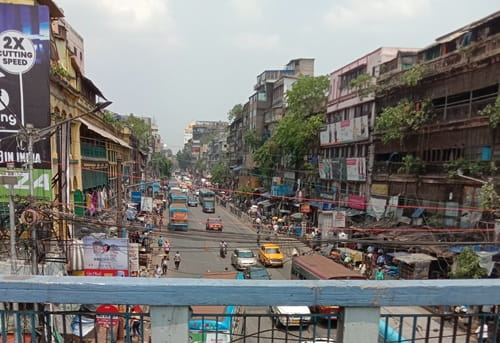
The name is literal and completely accurate. Bara Bazar means Big Market, and Kolkata’s Barabazar is precisely that — not a single market but a sprawling commercial district in the northern part of the city, near the Howrah Bridge and along Mahatma Gandhi Road, that has functioned as one of India’s most important wholesale trading zones since the British colonial era. When trade came to Calcutta during the East India Company period, it settled around the Hooghly riverbank and expanded northward through what became Barabazar. Cotton and textiles were the original trade. The zone eventually absorbed grain, spices, jewellery, hardware, plastics, chemicals, and the full spectrum of wholesale goods that a city of Kolkata’s commercial scale demands.
Walking through Barabazar today feels like navigating a city within a city. Handcarts loaded with fabric bolts navigate alongside delivery motorcycles. Wholesale dealers conduct transactions from the same addresses their fathers and grandfathers occupied. The commercial energy is entirely different from the organised retail of Kolkata’s malls or the cultural atmosphere of Gariahat.
Quick Overview: Barabazar Market Kolkata
| Detail | Information |
| Location | Mahatma Gandhi Road (MG Road), Barabazar, Kolkata, West Bengal – 700007 |
| Also Known As | Burrabazar |
| Area | Barabazar / Jorasanko, North-Central Kolkata |
| Established | Colonial era (British period, 18th–19th century) |
| Market Type | Wholesale commercial district — textiles, jewellery, spices, electronics, general merchandise |
| Key Roads | MG Road, Armenian Street, Biplabi Rash Behari Basu Road, Cotton Street, Ezra Street |
| Timings | 9:00 AM – 7:00 PM (most wholesale shops); closed Sunday |
| Weekly Off | Sunday |
| Nearest Metro | MG Road Station, Kolkata Metro Blue Line |
| Nearest Railway | Howrah Station (~1.2 km); Sealdah (~3 km) |
| Known For | Wholesale textiles, sarees, jewellery, spices, electronics, hardware, plastics, general wholesale trade |
Where Exactly Is Barabazar
Barabazar is located along Mahatma Gandhi Road (MG Road) in the Barabazar and Jorasanko area of north-central Kolkata, pin code 700007. The district is bounded approximately by the Howrah Bridge approach to the south-west, Netaji Subhas Road to the south, Chittaranjan Avenue to the east, and Jorasanko to the north. Armenian Street, Biplabi Rash Behari Basu Road, Cotton Street, and Ezra Street are the primary commercial roads within the zone, each with its own concentration of trade.
MG Road Metro Station on the Kolkata Metro Blue Line is the nearest metro access point, providing direct connectivity to Park Street, Esplanade, and the city’s central metro network. Howrah Station — one of India’s busiest railway junctions — is approximately 1.2 km from the market, making Barabazar accessible from across West Bengal and the broader Eastern Railway network. WBTC buses on multiple routes serve the MG Road and Jorasanko corridor. The Howrah Bridge, which spans the Hooghly just south of the market, is one of the most recognisable navigation landmarks for reaching the area from across the river.
Parking within Barabazar is essentially impossible during trading hours. The lanes are narrow, the handcart and delivery vehicle traffic is constant, and the footfall from wholesale buyers absorbs every inch of usable space. Metro and taxi are the only practical approaches; arriving by personal vehicle is strongly inadvisable.
What Shops You Will Find
Textiles and apparel wholesale are the heart of Barabazar’s trading identity. The market handles fabric wholesale for retailers across West Bengal and neighbouring states — sarees in Bengali handloom, silk, synthetic, and designer varieties; kurtis, dress materials, and ready-made garments at wholesale quantities. Armenian Street and Cotton Street carry the primary wholesale fabric trade, with dealers who supply to small retailers, boutiques, and the fashion trade across eastern India. Established firms like Jaswant Kumar Satyendra Kumar (dealing in ladies’ garments since 1976) have operated from Barabazar for generations.
Jewellery has its own trading district within Barabazar. Gold and silver jewellery wholesale, gemstone trading, and the supply chain that feeds Kolkata’s vast jewellery retail sector moves through dedicated lanes where established bullion and ornament traders have been operating since the colonial period.
Spices and dry goods wholesale mirrors the structure of Delhi’s Khari Baoli — dealers handling bulk quantities of spices, dried fruits, lentils, and food staples for distribution to retailers and food manufacturers across Bengal. Hardware, plastics, electrical goods, and industrial supplies occupy their own sections. Electronics wholesale — components, accessories, and consumer goods — has built a presence in the market alongside the older trades.
The wholesale character means that minimum quantities are expected by many dealers, though individual retail buyers can often purchase from wholesale shops with patience and willingness to buy the minimum lot size.
Food Near Barabazar
The area around Barabazar carries Kolkata’s working-class food culture — small restaurants serving Bengali fish curry and rice, Irani-style tea stalls, and the pavement snack vendors (jhalmuri, telebhaja) that are inseparable from Kolkata’s street life. The broader Jorasanko zone has established eateries that have served the market’s working population for decades. For a more structured meal after wholesale shopping, the Esplanade area is accessible by metro with significantly wider food options.
Nearby Areas Worth Visiting
Jorasanko Thakur Bari — the ancestral home of Rabindranath Tagore, now maintained as a museum and cultural institution — is within the Jorasanko neighbourhood adjacent to Barabazar. This is one of Kolkata’s most significant literary and cultural heritage sites. Howrah Bridge, with its remarkable cantilever structure and the dense human and vehicular traffic that makes it one of the world’s busiest bridges, is a short walk from the southern edge of the market zone. Mullik Ghat Flower Market — Kolkata’s largest wholesale flower market under the Howrah Bridge — is accessible in the same visit.
FAQs
Q1. What is Barabazar Market Kolkata famous for?
Barabazar (also called Burrabazar) is one of India’s oldest and largest wholesale commercial districts, located in north-central Kolkata near the Howrah Bridge. It is famous for wholesale textiles, sarees, gold and silver jewellery, spices, electronics, hardware, and general merchandise. The area has functioned as Kolkata’s primary wholesale hub since the British colonial era.
Q2. What are the timings of Barabazar Market Kolkata?
Most wholesale shops operate from 9:00 AM to 7:00 PM. Sunday is the primary weekly off day. The wholesale trade is most active from early morning through early afternoon; arriving before noon gives the best access to dealers and the freshest stock of goods.
Q3. Which metro station is nearest to Barabazar Market Kolkata?
MG Road Metro Station on the Kolkata Metro Blue Line is the nearest station, serving the Mahatma Gandhi Road zone that runs through the heart of Barabazar.
Q4. Can retail buyers shop at Barabazar, or is it wholesale only?
Barabazar is primarily a wholesale market, and many dealers expect bulk purchase quantities. However, individual retail buyers can often negotiate smaller quantities, particularly in the textile and spice sections. Buying close to minimum lot sizes and bargaining on price are both standard for non-wholesale buyers.
Q5. Is Barabazar Market suitable for sourcing textiles and sarees?
Yes. The textile wholesale sections — particularly along Armenian Street and Cotton Street — offer one of the widest selections of sarees, fabric, and garment wholesale available in eastern India, at pricing significantly below organised retail.