More than half of India’s urban homebuyers are expected to prefer gated communities by 2026, driven by a single, consistent theme running through nearly every buyer survey: security is now the biggest selling point in Indian real estate, ahead of even price or location. Yet independent properties, whether a standalone house or villa, still command genuine appeal for buyers who’d rather own their land outright and answer to no committee at all. Understanding exactly where a gated community earns its premium, and where an independent property genuinely wins despite the extra responsibility, matters before you commit to either lifestyle.
What Each Option Actually Is
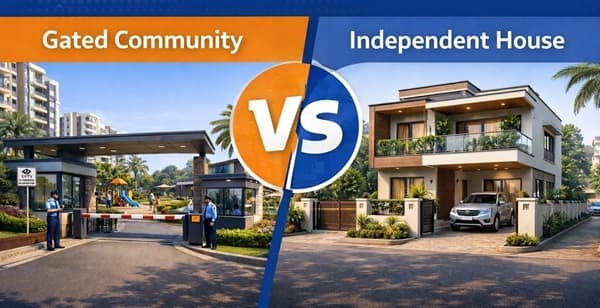
Before weighing pros and cons, it’s worth being clear about what these two categories structurally mean, since the distinction shapes every comparison that follows.
- A gated community refers to a residential development, apartments, villas, or plotted houses, run collectively by a single managing organisation, typically a builder-appointed body that later transitions to a Resident Welfare Association (RWA).
- Residents in a gated community share common facilities like playgrounds, gyms, security infrastructure, clubhouses, and parking, with maintenance costs pooled and collected monthly from all residents.
- An independent property is owned and managed entirely by the individual owner, with no common rules, no shared maintenance system, and full personal freedom over renovations, design, security arrangements, and daily upkeep.
Security — The Single Biggest Differentiator
Ask most buyers what drew them toward one option over the other, and security comes up more consistently than any other single factor.
- Most gated communities offer round-the-clock security with guards at the main gate supervising entries and exits, along with CCTV coverage, controlled access points, and electronic surveillance across common areas.
- Independent properties place security responsibility entirely on the owner, requiring the household to independently install and maintain alarm systems, surveillance cameras, and any other safety infrastructure they consider necessary.
- For NRI owners specifically, who often spend extended periods abroad, a gated community’s professional, round-the-clock security offers genuinely unmatched peace of mind for a property that would otherwise sit unmonitored for long stretches.
Amenities and Lifestyle Convenience
Beyond pure security, the day-to-day recreational and social infrastructure available differs enormously between these two living arrangements.
- Gated communities typically feature swimming pools, gyms, clubhouses, landscaped gardens, sports courts, and dedicated children’s play areas, all accessible without leaving the community, giving residents fitness and leisure options right at their doorstep.
- Many newer developments also include shopping complexes and ATMs within the community itself, a genuinely significant convenience upgrade over what a standalone independent property can offer on its own.
- Independent properties come with none of these shared facilities built in, any pool, gym, or garden space has to be personally constructed and maintained by the individual owner, at considerably higher personal cost and effort.
Maintenance — Managed vs. Self-Directed
How much ongoing effort a property demands from its owner is a genuinely important, if less glamorous, consideration that shapes daily life far more than amenities do.
- In a gated community, a professional management body, typically an RWA, handles maintenance, cleaning, and repairs, including water management and power backup in common areas, all funded through monthly maintenance charges collected from residents.
- Gated communities do carry higher maintenance costs precisely because they provide more amenities, a direct trade-off, more shared conveniences mean a correspondingly higher recurring bill.
- Independent property owners handle everything themselves, giving them complete financial control over spending but also full personal responsibility for every repair, from a leaking roof to a broken gate, with no dedicated staff or shared fund to draw on.
- Independent villas generally carry no HOA-style fees at all, resulting in genuinely lower ongoing costs for owners willing to take on that maintenance burden personally.
Privacy and Customization — Where Independent Properties Clearly Win
For buyers who value complete control over their living space above all else, independent properties offer something gated communities structurally cannot replicate.
- Independent properties provide complete control over design and features, from architectural style to interior decor, letting owners create a space that genuinely reflects their personal taste without needing committee approval.
- With no shared walls or communal areas, independent properties ensure a high degree of privacy and personal space, ideal for those who specifically value solitude and a quieter environment.
- Homeowners in independent properties have full freedom regarding renovations, expansions, and daily management decisions, whereas gated community residents typically need RWA approval for anything affecting the building’s shared exterior or structure.
Resale Value — A Genuine Advantage for Gated Communities
Long-term financial outcomes genuinely differ between the two formats, and this is worth weighing alongside the day-to-day lifestyle considerations.
- Well-maintained gated communities generally enjoy higher resale demand and better resale value than independent properties in comparable areas, since buyers actively seek out the convenience, security, and modern facilities that come bundled with them.
- Homes in gated communities usually sell faster and at a better price than standalone properties, reflecting genuinely stronger and more consistent buyer demand in urban markets specifically.
- Independent properties, meanwhile, can offer strong land value appreciation over the long term, sometimes making them a genuinely compelling long-term investment despite their comparatively slower, more location-dependent resale process.
Community and Social Life
Beyond physical infrastructure, the sense of belonging and neighbourly connection differs meaningfully between these two living arrangements.
- Gated communities foster strong community bonds through organised events, festivals, and neighbourhood gatherings, helping residents build genuine social connections, particularly valuable for families and returning NRIs seeking familiarity and belonging.
- Independent properties offer no built-in social structure, whatever community connection develops happens organically with neighbours rather than through any organised, managed framework.
- Tenants with children are genuinely more likely to stay long-term in gated communities, since these developments offer a safe, comfortable environment with dedicated play areas that standalone properties typically can’t match.
When a Gated Community Is Genuinely the Better Choice
- You’re a working family, or have children or senior citizens at home who’d benefit from consistent, professionally managed security.
- You want shared amenities, a swimming pool, gym, clubhouse, without personally managing or maintaining them.
- You’re an NRI owner needing reliable security and management for a property you won’t be personally overseeing full-time.
- You prioritize stronger, faster resale demand in an active urban market.
When an Independent Property Is Genuinely the Better Choice
- You value complete privacy and freedom from shared walls, committees, or communal decision-making.
- You want full control over renovation, design, and expansion, without needing anyone’s approval.
- You’re prioritizing long-term land value appreciation over shorter-term resale liquidity.
- You’d rather manage your own maintenance and security directly, keeping ongoing costs lower in exchange for taking on that personal responsibility.
The Bottom Line
Gated communities and independent properties genuinely serve different priorities rather than one being universally better, gated communities deliver security, amenities, managed maintenance, and stronger resale demand at the cost of monthly charges and reduced personal control, while independent properties deliver privacy, full customization freedom, and genuine land ownership at the cost of taking on maintenance and security responsibility entirely on your own. The right choice genuinely comes down to whether you prioritize convenience and community, or privacy and complete control, provided either option meets your family’s specific security, budget, and lifestyle needs. This is general informational content, not personalised financial or legal advice; consulting a real estate adviser about your specific city, budget, and family situation remains genuinely worthwhile before committing to either option.
Frequently Asked Questions
Q1. Are gated communities genuinely safer than independent properties, or is this mostly marketing?
A: Gated communities do offer structurally stronger, professionally managed security, round-the-clock guards, CCTV, and controlled access points, compared to independent properties where security depends entirely on whatever measures the individual owner personally installs, making gated communities the objectively more consistent option for families prioritizing safety without personal management effort.
Q2. Why do gated communities generally have higher resale value than independent properties in the same area?
A: Buyers actively seek out the convenience, security, and modern amenities that come bundled with gated communities, creating stronger and more consistent demand, whereas independent property resale depends heavily on that specific plot’s location and condition, appealing to a narrower, more particular pool of buyers.
Q3. Is it true that independent properties have no ongoing costs the way gated communities do?
A: Not entirely, independent properties typically avoid HOA-style monthly maintenance fees, but owners still bear the full cost of their own upkeep, repairs, and any security infrastructure they choose to install, meaning the absence of a fixed monthly charge doesn’t mean the absence of ongoing expense, it simply shifts that cost to the owner’s direct control.
Q4. Which option is genuinely better for NRI buyers who won’t be in India most of the year?
A: Gated communities are generally considered the stronger choice for NRIs specifically, since their professional, round-the-clock security and managed maintenance provide genuine peace of mind for an absentee owner, whereas an independent property would require the NRI to arrange and coordinate security and upkeep remotely, a considerably more demanding logistical challenge.