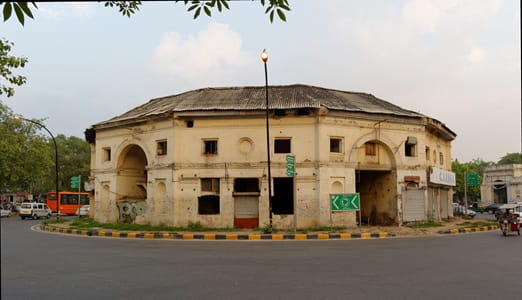
Not every market in Delhi is defined by what it sells. Some are defined by what they are — architecturally, historically, atmospherically. Gole Market in Lutyens’ Delhi belongs to that second category. Built in 1921 by British architect Edwin Lutyens as part of his grand vision for the new colonial capital, the market’s dodecagonal outer structure and octagonal inner layout made it one of the most distinctive civic buildings in the city. For decades it served as a neighbourhood hub for government employees living in the bungalows of central New Delhi — a place for groceries, confectioneries, sweet shops, and the kind of daily errand running that a small, well-positioned market handles.
Today, Gole Market occupies an unusual transitional moment. The main heritage building has been closed for years following a 2007 NDMC declaration of structural unsafety. A Rs 21.66 crore restoration project — converting it into the Veerangana Museum dedicated to women achievers — was launched by Delhi’s Lieutenant Governor in late 2023. The project has faced repeated deadline extensions: the original August 2025 target slipped to March 2026, then to May 2026, with officials in March 2026 citing GRAP anti-pollution stoppages as contributing to further delays. The restoration involves retrofitting the 1,407 sq.m structure, adding a glass dome, constructing a pedestrian subway to RK Ashram Marg, and installing eight galleries spotlighting women from Rani Laxmibai to Sushma Swaraj. As of mid-2026, the project remains ongoing.
What continues to operate — and to draw visitors — is the ring of shops, eateries, and heritage food establishments that have surrounded the central structure for generations.
Quick Overview: Gole Market Delhi
| Detail | Information |
| Location | Gole Market, Banga Bhavan Marg, RK Ashram Marg, New Delhi – 110001 |
| Area | Lutyens’ Delhi, Central New Delhi |
| Built | 1921, designed by Edwin Lutyens |
| Architecture | Dodecagonal exterior, octagonal interior; 28 original shop units |
| Main Building Status | Under restoration as Veerangana Museum (ongoing as of 2026) |
| Surrounding Shops Timings | 9:00 AM – 8:00 PM (general); eateries up to 9:00 PM |
| Nearest Metro | Rajiv Chowk Station, Yellow/Blue Line (~1 km); RK Ashram Marg Station, Blue Line |
| Known For | Colonial architecture, heritage eateries, sweet shops, neighbourhood food culture |
| Parking | Limited; metro recommended |
Where Exactly Is Gole Market
Gole Market is located on Banga Bhavan Marg near RK Ashram Marg in central New Delhi, pin code 110001. It sits inside a traffic roundabout — the circular placement is part of Lutyens’ original design logic — surrounded by the wide, tree-lined roads of Lutyens’ Delhi. Connaught Place is within easy walking distance to the south. Parliament House and the Secretariat complex are close to the north-east. New Delhi Railway Station is nearby, and India Gate is accessible by a pleasant walk through the Lutyens’ zone.
The nearest metro station is Rajiv Chowk on the Yellow and Blue Lines, approximately 1 km away. RK Ashram Marg Station on the Blue Line is also very close. Both are walkable for those comfortable with a 10-minute walk through the wide, pleasant roads of central New Delhi. DTC buses serve the area on multiple routes.
What You Will Find Here
The original 28 shops of Gole Market — which once carried everything from confectionery to meat products and attracted some of Delhi’s most beloved food establishments — were largely evicted following the 2007 unsafe building declaration and subsequent court proceedings. What remains active is the outer ring of establishments and the food culture that has organically built up around the heritage structure.
Bangla Pastry Shop has been a neighbourhood institution for generations, known for patties, cakes, and biscuits in the classic Anglo-Indian bakery tradition. Kaleva continues to draw loyal customers for its gajar ka halwa, samosas, and traditional North Indian mithai. Odean Sweets is another heritage name for classical Indian sweets. Old meat shops and tandoori joints — Galina and Deluxe Chicken among them — carry recipes and reputations from the 1960s. Saraswati Book Depot reflects the area’s traditionally strong Bengali residential community, stocking literature and cultural texts. Tailors, pet shops, and stationery stores serve the local residents who continue to live in and around this part of central New Delhi.
The market’s strongest draw for visitors who are not regulars is its architecture and atmosphere. The colonial-era arches, the circular layout, the shaded colonnade, and the particular quality of a neighbourhood that has been inhabited by Delhi’s administrative class for over a century combine into something that is genuinely hard to replicate. Evenings between 4 PM and 7 PM, when the colonial arches catch the light and the food counters get busy, are particularly atmospheric.
The Veerangana Museum — Current Status
The restoration project is the most significant development in Gole Market’s recent history. When complete, the Veerangana Museum will house eight galleries celebrating Indian women achievers across art, literature, science, culture, social service, and the independence movement. A glass dome will crown the restored structure, and a pedestrian subway will connect the building to RK Ashram Marg. As of June 2026, the project deadline had been extended multiple times and work was continuing. Visitors can see the scaffolded exterior from the surrounding road and the active construction in progress.
Nearby Areas Worth Visiting
Connaught Place — Delhi’s iconic circular commercial and heritage district — is within comfortable walking distance. The Gole Dak Khana (New Delhi General Post Office), another Lutyens-era octagonal structure built in 1931, is approximately 800 metres away and worth seeing for its architectural similarity to Gole Market. India Gate is accessible on foot through the wide Rajpath corridor. Hanuman Mandir on Baba Kharak Singh Marg is a major religious site minutes away. The National Museum on Janpath is a short taxi ride.
FAQs
Q1. What is Gole Market Delhi famous for?
Gole Market is known primarily as a Lutyens-era heritage structure — a 1921 Edwin Lutyens design in the form of a circular market building at a roundabout in central New Delhi. It is also remembered for its legacy food establishments including Kaleva and Bangla Pastry Shop. The main building is currently under restoration to become the Veerangana Museum.
Q2. Can visitors enter Gole Market’s main building in 2026?
No. The central building has been closed for structural safety reasons since 2007 and is currently under an active Rs 21.66 crore restoration project. The surrounding shops, eateries, and the building’s exterior can be visited freely. The Veerangana Museum project had faced multiple deadline extensions as of mid-2026, with completion still pending.
Q3. What are the timings of Gole Market?
The surrounding shops and eateries operate from approximately 9:00 AM to 8:00 PM daily. Food establishments may extend to 9:00 PM. Individual establishment hours vary — the heritage bakeries and sweet shops typically open by mid-morning.
Q4. Which metro station is nearest to Gole Market?
Rajiv Chowk Station on the Yellow and Blue Lines is the closest major station, about 1 km from Gole Market. RK Ashram Marg Station on the Blue Line is equally accessible. Both are within comfortable walking distance through Lutyens’ Delhi’s wide roads.
Q5. What will the Veerangana Museum at Gole Market contain?
The planned museum will feature eight galleries dedicated to Indian women achievers spanning art, literature, culture, science, social service, and the freedom struggle. The Rs 21.66 crore project includes retrofitting the original structure, adding a glass dome, and building a pedestrian subway connecting to RK Ashram Marg. A curatorial consultancy tender was released in February 2026. Completion timelines remain subject to ongoing revision.