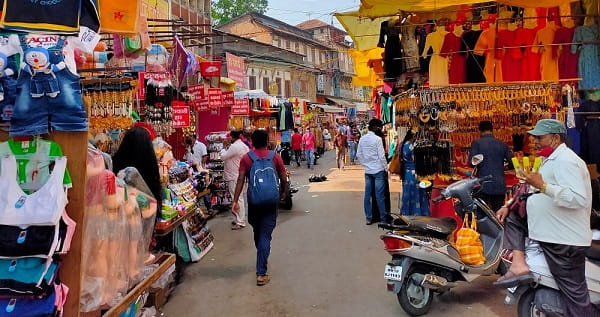
Old Pune is a city of wadas, temples, narrow peth lanes, and the kind of daily commerce that has been running continuously for three centuries. Tulsi Baug sits inside this historic core — a compact but extraordinarily dense market lane in Budhwar Peth, perpendicular to the famous Laxmi Road, running alongside the Tulshibaug Ram Mandir that gives it its name. The temple predates the British presence in Pune by several decades, built during the Peshwa era under the subhedar Naro Appaji Khire in the 1760s. The statues of Ram, Sita, and Lakshmana were installed in the sanctum in November 1765. The market grew organically around this religious centre, as markets across India’s old cities invariably do — pilgrims needing offerings, traders positioning themselves near a steady flow of devotees, and daily-need commerce filling the gaps.
What exists today is a market that has changed surprisingly little in its character while absorbing the full range of contemporary consumer needs. Three and four-generation family shops operate alongside newer vendors. Sarees hang beside cosmetics counters. Bangle shops neighbour stainless steel kitchen wholesalers. And through all of it, the Tulshibaug Ram Mandir stands at the lane’s heart, ensuring that the market has never drifted too far from the community purpose that built it.
Quick Overview: Tulsi Baug Market Pune
| Detail | Information |
| Location | Opposite Vishrambaug Wada, Budhwar Peth, Laxmi Road, Pune – 411046 |
| Area | Old Pune, Budhwar Peth |
| Historical Roots | Peshwa era; market grew around Tulshibaug Ram Mandir (built 1760s) |
| Market Type | Traditional neighbourhood street market |
| Timings | 10:00 AM – 9:00 PM (daily) |
| Weekly Off | No fixed weekly off; some individual shops closed on Mondays |
| Nearest Metro | Budhwar Peth Metro Station, Pune Metro Purple Line (~4 min walk, operational since 2025) |
| Known For | Sarees, bangles, kitchenware, costume jewellery, religious items, household goods |
| Parking | Tulshibaug Multilevel Parking behind Ram Mandir (~400 cars, 1,200 bikes); two-wheelers strongly recommended |
Where Exactly Is Tulsi Baug
Tulsi Baug Market is located opposite Vishrambaug Wada in Budhwar Peth, along Laxmi Road, Pune 411046. The market lane runs perpendicular to Laxmi Road — Pune’s most famous shopping street — meaning visitors typically approach via Laxmi Road and turn into the Tulsi Baug lanes from there. Vishrambaug Wada, a heritage Peshwa-era residential complex, sits directly opposite the market entrance.
Since 2025, the Budhwar Peth Metro Station on Pune Metro’s Purple Line has been operational, placing a metro connection approximately a four-minute walk from the Tulsi Baug entrance — a significant improvement in accessibility for a market that had previously been primarily auto-rickshaw or two-wheeler territory. From Civil Court Metro Station, it is one stop. By auto-rickshaw from Pune Junction Railway Station, the journey is approximately 2.8 km and costs around Rs 80 to 110 by meter. Shivaji Nagar Railway Station is 3.2 km away.
Driving is genuinely inadvisable. The Budhwar Peth lanes are narrow, one-way in sections, and chronically congested during market hours. If a vehicle is unavoidable, the Tulshibaug Multilevel Parking behind the Ram Mandir charges Rs 30 per hour for cars and Rs 10 per hour for two-wheelers, with capacity for around 400 cars and 1,200 bikes.
What Shops You Will Find
Sarees are Tulsi Baug’s defining textile category. The inner lanes behind the Ram Mandir carry shops dealing in cotton sarees, silk sarees, and synthetic blends in the full range of price points. Nauvari sarees — the nine-yard Maharashtrian style worn during festivals and traditionally significant occasions — are particularly well-represented here in a way they are not in the city’s newer commercial areas. Dress materials, blouse pieces, and matching fabrics are available from small specialist shops throughout the inner lanes.
Bangles are the market’s most photographed category. Dozens of bangle shops carry glass bangles, lac bangles, metal bangles, and bridal bangle sets in every colour and style. Brides from across Pune’s traditional families come here specifically for bangle shopping before weddings. The variety and pricing are genuinely difficult to match in modern retail.
Kitchenware — stainless steel vessels, pressure cookers, brass puja thalis, storage containers, and everyday utensils — occupies a significant commercial lane in Tulsi Baug. The proximity to the Ram Mandir means religious items are well-represented: incense, oil wicks, puja accessories, idol stands, and devotional prints fill dedicated shops around the temple’s immediate perimeter. Costume jewellery, footwear, cosmetics, bags, stationery, and household plastic goods round out the product offering.
Specialty food and spice shops in the inner lanes behind the temple carry Kolhapuri masala, goda masala (the aromatic Maharashtrian spice blend), thalipeeth bhajani, kanda lasun chutney powder, sandgi mirchi, and homemade lonche (pickles) — practical Maharashtrian pantry items that travel well and make distinctive gifts. UPI is now accepted across most stalls in 2026. Cash remains preferred by the oldest shops. Bargaining is appropriate for apparel and costume jewellery — vendors typically open at 30 to 50 percent above realistic price. Kitchenware and brassware are closer to fixed pricing.
Food Near Tulsi Baug
The Budhwar Peth area is one of Pune’s most authentic food zones. Near the Tulsi Baug entrances, misal pav, sabudana vada, freshly squeezed juices, and local snacks are available from street stalls through the day. Bhide Vatika and Joshi’s are among the established eateries in the vicinity for Puneri thali meals and traditional snacks. Dagdusheth Halwai Ganapati Temple — one of Pune’s most famous Ganesh shrines — is a short walk away and the surrounding lanes have sweet shops and mithai sellers that are standard stops on any Budhwar Peth visit.
Nearby Areas Worth Visiting
Shaniwar Wada — the 18th-century fortified palace that served as the seat of Peshwa power — is about 500 metres from Tulsi Baug and one of Pune’s most significant historical landmarks. Dagdusheth Halwai Ganapati Temple, surrounded by constant devotional activity and famous for its elaborate Ganesh idol, is a 5-minute walk. Vishrambaug Wada — the heritage Peshwa-era mansion directly opposite the market entrance — is worth a slow look at its carved wooden architecture, though access to the interior is limited. Laxmi Road itself, Pune’s main shopping street with a mix of branded retail and traditional shops, begins at the Tulsi Baug junction and extends through the city’s commercial core.
FAQs
Q: What is Tulsi Baug Market Pune famous for?
A: Tulsi Baug is one of Pune’s oldest and most beloved traditional markets, best known for sarees — particularly Nauvari sarees and cotton Maharashtrian textiles — bangles, kitchenware, costume jewellery, religious items, and Maharashtrian spices. It grew around the historic Tulshibaug Ram Mandir built during the Peshwa era in the 1760s.
Q: What are the timings of Tulsi Baug Market Pune?
A: The market operates from 10:00 AM to 9:00 PM daily. There is no fixed weekly off, though some individual shops close on Mondays. The market is busiest in the afternoons and evenings, particularly on weekends.
Q: Which is the nearest metro station to Tulsi Baug Market Pune?
A: Budhwar Peth Metro Station on Pune Metro’s Purple Line is the closest, operational since 2025 and approximately a four-minute walk from the Tulsi Baug entrance. From Civil Court interchange, it is one metro stop.
Q: Is bargaining expected at Tulsi Baug Market?
A: Yes, for clothing, sarees, costume jewellery, and accessories. Vendors in these categories typically open at 30 to 50 percent above the realistic selling price. Kitchenware and brassware shops are closer to fixed pricing. UPI payments are accepted across most stalls.
Q: Is parking available at Tulsi Baug Market?
A: The Tulshibaug Multilevel Parking behind the Ram Mandir has capacity for approximately 400 cars and 1,200 bikes. Two-wheelers are strongly recommended over cars given the narrow, congested lanes of Budhwar Peth. Metro or auto-rickshaw from the railway station or metro interchange is the most practical approach.