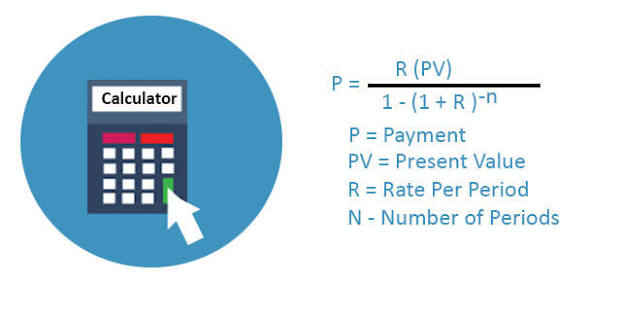
Loan calculators calculate monthly EMI payments using a formula that looks intimidating at first glance — EMI = [P × R × (1+R)^N] ÷ [(1+R)^N − 1] — but understanding where it actually comes from, and what happens when a calculator needs to solve the problem in reverse, reveals something most people never realize: while finding your EMI from a known loan amount, rate, and tenure is straightforward algebra, working backward to find your effective interest rate from a known EMI has no clean formula at all. Calculators solving that reverse problem are quietly guessing and refining their way to an answer, not computing one directly.
| Quick Facts | Details |
| The underlying mathematical concept | Present value of an annuity |
| Forward calculation (P, R, N known, solve for EMI) | Direct algebraic substitution — always solvable exactly |
| Solving for tenure (P, R, EMI known, solve for N) | Requires logarithms, since N sits in an exponent |
| Solving for interest rate (P, N, EMI known, solve for R) | No closed-form solution exists — calculators use iterative numerical methods |
| Common method for this iterative solving | Newton-Raphson approximation or repeated trial-and-error narrowing |
| Where this reverse problem shows up practically | Converting a flat interest rate into its reducing-balance equivalent |
Here’s the genuinely surprising part of how these calculators work under the hood: if you know your loan amount, tenure, and monthly EMI, and you want to find out what interest rate you’re actually paying, there’s no algebraic formula that isolates the rate directly. The rate appears both multiplied against the principal and buried inside an exponent simultaneously, and no amount of algebraic rearrangement separates it cleanly. Every calculator that shows you an “effective interest rate” from these three inputs is running an iterative approximation behind the scenes — starting with a guess, checking how close it lands, and refining that guess repeatedly until the result converges close enough to the real answer.
Where the EMI Formula Actually Comes From
Before looking at how calculators solve forward and backward versions of this problem, it’s worth understanding the underlying financial logic the formula represents.
- A loan is essentially the reverse of a savings annuity: instead of you depositing equal amounts and watching them grow, the lender hands you a lump sum today, and you repay it through equal monthly installments
- The mathematical principle connecting these is present value — the idea that a rupee received or paid in the future is worth less than a rupee today, discounted by the interest rate over the time until that payment happens
- Setting the loan amount equal to the sum of all future EMI payments, each discounted back to today’s value at the monthly interest rate, produces a geometric series
- Summing that geometric series algebraically and rearranging to solve for the EMI itself produces the standard formula every bank and calculator uses
The Forward Calculation: Solving for EMI
This is the version everyone’s familiar with, and it’s the only one of the three that can be solved through simple, direct substitution.
- Given a principal (P), monthly interest rate (R), and tenure in months (N), you calculate (1+R) raised to the power N, then plug that value directly into the formula
- For example, a ₹30 lakh loan at 9% annual interest over 20 years converts to a monthly rate of 0.0075 and a tenure of 240 months
- Working through the formula step by step, (1.0075)^240 comes to approximately 6.0092, which feeds directly into the numerator and denominator to produce an EMI of approximately ₹26,993
- Over the full 240 months, total repayment comes to roughly ₹64.78 lakh, meaning total interest paid is around ₹34.78 lakh — an interest-to-principal ratio of 116%, meaning you ultimately repay more than double what you originally borrowed
Solving Backward for Tenure: Why Logarithms Enter the Picture
A different, genuinely more complex calculation happens when you know your budget for a monthly payment and want to find out how long it’ll take to clear the loan.
- If you know the principal, the monthly rate, and your target EMI, and you want to solve for how many months (N) it’ll take to fully repay the loan, N sits as an exponent in the original formula
- Isolating an exponent algebraically requires taking a logarithm of both sides of the equation, which produces a distinct formula: N = −log(1 − (P×R)/EMI) ÷ log(1+R)
- This is still a closed-form solution — a calculator can compute it exactly, in one step, without any guessing — but it requires logarithmic functions rather than simple algebra
- This is precisely the calculation behind “how long will it take me to pay off this loan at ₹X per month” tools, distinct from the standard EMI calculator most people use
Solving Backward for Interest Rate: Why There’s No Clean Formula At All
This is the genuinely distinctive case, and it’s worth understanding clearly since it explains a real limitation in how certain financial tools actually function.
- If you know the principal, the tenure, and the EMI, and you want to solve for the interest rate (R) being charged, R appears in two separate places in the formula simultaneously — multiplied directly against the principal, and also buried inside the (1+R)^N exponential term
- No algebraic technique exists that can isolate a variable appearing in both a linear term and an exponential term within the same equation — this is a well-established mathematical limitation, not a gap in someone’s cleverness
- Calculators instead solve this using iterative numerical methods, most commonly a technique called Newton-Raphson approximation, which starts with an initial guess for R, checks how far the resulting EMI is from the actual known EMI, and adjusts the guess repeatedly until the error shrinks close enough to zero
- This process typically converges to an accurate answer within a handful of iterations, running invisibly in milliseconds — but it’s fundamentally a refined guess-and-check process, not a direct computation the way solving for EMI or tenure is
Where This Actually Matters: Flat-to-Reducing-Balance Converters
This iterative-solving mechanic isn’t just a mathematical curiosity — it’s exactly what powers a specific, genuinely useful category of calculator covered throughout discussions of flat-rate versus reducing-balance loans.
- When converting a flat interest rate loan into its reducing-balance equivalent, the calculator first computes the EMI under the flat-rate assumption
- It then treats that EMI as a known value, along with the known principal and tenure, and solves backward for the reducing-balance rate that would produce that same EMI
- Since this is precisely the “solve for R” problem with no closed-form solution, every flat-to-reducing-balance converter is running an iterative approximation internally, even though the tool presents a single, clean final percentage
- This is the underlying mechanism behind commonly cited conversions — a 10% flat rate translating to roughly 17-18% reducing balance, or a 12% flat rate translating to roughly 21.5% reducing balance — each of these approximate figures was itself derived through this same iterative process, not a direct formula
What This Means for the Calculator You’re Using
Understanding this distinction has a genuinely practical implication for how much precision to expect from different types of calculators.
- A standard EMI calculator, solving the forward problem, will always produce an exact, mathematically precise figure given accurate inputs
- A tenure calculator, solving with logarithms, is similarly exact
- An effective-rate or flat-to-reducing-balance calculator, solving the reverse rate problem, is producing a very close approximation rather than a mathematically exact figure — though the difference is typically negligible for practical purposes given how quickly these iterative methods converge
- Two different calculators computing an effective rate from the same inputs might show results differing by a tiny fraction of a percent, simply due to different convergence thresholds or rounding in their respective iterative processes — this is normal and doesn’t indicate either tool is wrong
This is general educational information about the mathematics behind loan calculators, not financial advice. The underlying formulas are standard across the industry, though specific calculator implementations can vary slightly in precision and rounding conventions.
FAQs
Q1. Why can a calculator instantly tell me my EMI, but takes a different approach to tell me my effective interest rate?
Solving for EMI is a direct algebraic calculation with one exact answer, while solving for the interest rate requires iterative approximation since the rate can’t be mathematically isolated from an equation where it appears both linearly and as an exponent.
Q2. Is an “effective interest rate” shown by a flat-to-reducing-balance calculator exact or approximate?
It’s a very close approximation, produced through iterative numerical methods like Newton-Raphson approximation, since no direct formula exists to solve for interest rate given a known EMI, principal, and tenure.
Q3. Where does the standard EMI formula actually come from mathematically?
It derives from the present value of an annuity — treating a loan as the sum of all future EMI payments, each discounted back to today’s value, then rearranging that geometric series to solve for the fixed monthly payment amount.
Q4. Why do calculators need logarithms to figure out my loan’s remaining tenure?
Because tenure appears as an exponent in the EMI formula, and isolating an exponent algebraically requires taking a logarithm of both sides of the equation, producing a distinct formula from the standard EMI calculation.
Q5. Could two calculators show slightly different effective interest rates for the same loan details?
Yes, this can happen due to differing convergence thresholds or rounding conventions in their respective iterative calculations, though the difference is typically negligible for practical decision-making.
Q6. Does understanding the formula’s derivation change how I should use a loan calculator practically?
Not directly, but it explains why some calculator features (like effective rate conversion) are approximations rather than exact figures, which is useful context when comparing results across different tools.