Janpath Road has two lives. In its official function, it is a ceremonial artery of Lutyens’ Delhi — originally called “Queen’s Way,” running from Connaught Place toward the cultural and institutional buildings of Central Vista. Its name change to “Janpath,” meaning the People’s Path, was deliberate and symbolic. The street market that runs along this road has earned that name honestly. Janpath Market is where Tibetan refugees sell silver jewellery and thangka paintings, where Gujarati traders carry mirror-work fabric and block-printed textiles, where Kashmiri merchants display pashmina shawls and hand-embroidered kurtis, and where Delhi’s college students, tourists from every continent, and office workers from nearby Connaught Place converge in a mix that no mall can replicate.
It is one of the most culturally diverse markets in any Indian city — not diverse in the curated, festival-stall sense but in the genuine sense of different communities maintaining their commercial presence on the same street, year after year, with customers who return specifically because they know where to find what they want.
Quick Overview: Janpath Market Delhi
| Detail | Information |
| Location | Janpath Road, Connaught Place, New Delhi – 110001 |
| Original Name | Queen’s Way (colonial era) |
| Area | Central New Delhi, Lutyens’ Zone |
| Market Type | Open-air street market — handicrafts, fashion, Tibetan and Gujarati goods |
| Timings | 10:00 AM – 8:30 PM (Monday to Saturday); 11:00 AM – 9:00 PM (Sunday) |
| Weekly Off | None fixed; market operates all 7 days |
| Nearest Metro | Janpath Station, Violet Line (~2 min walk from Gate 2) |
| Also Near | Rajiv Chowk Station, Yellow and Blue Lines (~5 min walk) |
| Known For | Tibetan handicrafts, Gujarati textiles, Kashmiri shawls, silver jewellery, vintage accessories |
| Parking | Extremely limited; metro strongly recommended |
Where Exactly Is Janpath Market
Janpath Market stretches along Janpath Road in central New Delhi, between Connaught Place and Tolstoy Marg, pin code 110001. The market occupies the pavement and stall areas on the western side of Janpath Road, running roughly from the Tibetan Market section near the Janpath Metro Station entrance southward toward the Gujarati and general fashion sections.
The Janpath Metro Station on the Violet Line is the closest transit point — Gate 2 exits practically into the Tibetan Market section, making the walk to the first stall a matter of seconds. Rajiv Chowk Metro Station, the major interchange on the Yellow and Blue Lines, is a five-minute walk from the northern end of the market. The combination of these two stations makes Janpath one of the most metro-accessible markets in Delhi — reachable without a transfer from virtually any part of the city.
Driving to Janpath is inadvisable given the central location, constant traffic, and near-total absence of parking. Buses to Connaught Place or India Gate stop at Janpath bus stop, directly in front of the market. Auto-rickshaws and app-based cabs drop at the Janpath Road entrance.
What Shops You Will Find
The Tibetan Market section, immediately after exiting Gate 2 of Janpath Metro Station, is the market’s most culturally specific zone. Tibetan and Himalayan crafts — thangka paintings, prayer wheels, singing bowls, silver jewellery with turquoise and coral, protection amulets, incense, and Tibetan weave items — are sold by vendors from the Tibetan refugee community. Shops like Handicraft Good Store (Shop No. 22) and Tibetan Arts (Shop No. 17) are among the established names. The silver jewellery here, sold by artisans who make the pieces themselves or source from Tibetan craftspeople in Delhi and Dharamsala, represents some of the most genuine craft jewellery available anywhere in the city at accessible prices.
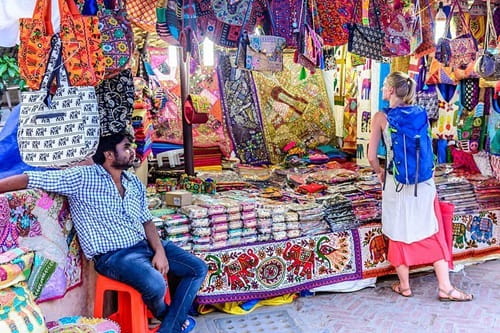
Further along the road, the Gujarati Market section carries mirror-work fabrics, block-printed textiles, embroidered bags, kutch-work accessories, and handloom clothing in the craft tradition of Gujarat. Quality here is typically a step above the general fashion section, and the vendors know their materials well enough to distinguish between machine and hand work when asked directly.
The general market section — running through the central stretch of Janpath — carries the broadest range: cotton kurtas, indo-western fashion, bohemian-style clothing, leather footwear, jute bags, sunglasses, accessories, vintage-look jewellery, home décor items, Rajasthani puppets, miniature paintings, and the full spectrum of souvenir shopping that Delhi’s tourist-facing markets are built around. Books — second-hand paperbacks, Indian literature, and cultural texts — appear from pavement vendors who cater to the considerable number of foreign visitors who pass through daily.
The market also has fixed-price Kashmiri shops selling pashmina shawls, woolen scarves, and embroidered suits. These operate differently from the bargaining stalls — prices are set, and the quality is generally consistent, making them a more reliable option for buyers who are not confident assessing shawl quality through feel and inspection.
Prices across Janpath are negotiable at the stalls and typically high at first quote — vendors dealing with tourist-heavy footfall often open at 100 to 150 percent above the realistic selling price. Shopping across four to five vendors before committing produces significantly better results than buying from the first stall with an attractive display.
Food Near Janpath Market
The market’s central location means excellent food options are within minutes in every direction. Connaught Place’s restaurant zone is a five-minute walk — from Wenger’s and Keventer’s to the full range of Indian and international dining. Street food within the market area itself includes chaat, juice counters, and chai stalls that sustain the vendor community and the browsing crowd. Palika Bazaar, the underground market at Connaught Place, is adjacent for those who want to extend shopping into electronics and fashion after covering Janpath.
Nearby Areas Worth Visiting
Connaught Place’s inner and outer circles, Jantar Mantar, India Gate, the National Museum, Agrasen Ki Baoli (a 60-step medieval stepwell hidden between commercial buildings), and Gurudwara Bangla Sahib are all within a 15-minute walk. The Central Vista redevelopment zone, Parliament House, and Rashtrapati Bhavan are accessible via the ceremonial Kartavya Path that runs from India Gate. Janpath Market functions naturally as the starting or ending point of a full day in central Delhi.
FAQs
Q1. What is Janpath Market Delhi famous for?
Janpath Market is Delhi’s most culturally diverse street market, famous for Tibetan handicrafts and silver jewellery, Gujarati mirror-work textiles, Kashmiri pashmina shawls, bohemian fashion, and budget accessories. It draws tourists, college students, and local shoppers in equal measure and is one of the city’s most visited street markets.
Q2. What are the timings of Janpath Market Delhi?
The market operates from 10:00 AM to 8:30 PM, Monday through Saturday. On Sundays it opens at 11:00 AM and closes by 9:00 PM. The market runs every day of the week without a fixed weekly off.
Q3. Which metro station is nearest to Janpath Market Delhi?
Janpath Metro Station on the Violet Line is the closest — Gate 2 exits practically into the Tibetan Market section, a walk of under two minutes. Rajiv Chowk Station on the Yellow and Blue Lines is a five-minute walk from the market’s northern end.
Q4. What is the best strategy for shopping at Janpath Market?
Browse at least four to five vendors for any item before buying. First-quoted prices at tourist-facing stalls are typically 100 to 150 percent above the realistic selling price. Walking away often prompts better offers. The fixed-price Kashmiri shawl shops are more reliable for first-time buyers who cannot assess quality independently.
Q5. Is Janpath Market good for tourists?
Yes, and it is particularly well-suited for first-time visitors to Delhi. The Tibetan Market section offers genuine Himalayan crafts, the Gujarati section carries quality handloom textiles, and the variety of affordable souvenirs, accessories, and clothing makes it one of the best value markets in central India for travellers on a budget.