Around 40% of crypto day traders quit within their first three months, not because the market lacks opportunity, but because they trade on gut feeling and pattern-chasing rather than a repeatable, disciplined system. The crypto market averaged $264.5 billion in daily trading volume through 2025, genuinely one of the most active arenas for short-term traders anywhere in finance, and it runs 24/7 with no closing bell, no weekend pause, and no circuit breaker forcing a cooldown. Understanding exactly how day trading actually works, and being honest about how brutally difficult it is to do profitably, matters far more than any single indicator or strategy you’ll read about.
What Day Trading Actually Means
Day trading crypto means buying and selling digital assets within the same trading session, aiming to profit from short-term price swings rather than long-term growth in a project’s underlying value.
- No overnight holding: unlike investing, where you might hold Bitcoin for years, day trading closes every position within the same session, never carrying risk into the next day.
- Small, repeatable gains, not one big win: traders typically target price movements of roughly 0.5% to 5% per trade, accumulating profit through volume and frequency of trades rather than betting big on a single dramatic move.
- “Day” is flexible in crypto: since the market never closes, a trading “day” often refers to a single session of active, concentrated monitoring rather than a fixed market-hours clock the way it works with stocks.
- This is fundamentally different from long-term investing, which focuses on a protocol’s fundamental growth over years; day trading prioritizes short-term price action and technical indicators almost exclusively.
The Core Tools Every Day Trader Relies On
Day trading is built almost entirely around technical analysis rather than fundamental research into what a project actually does.
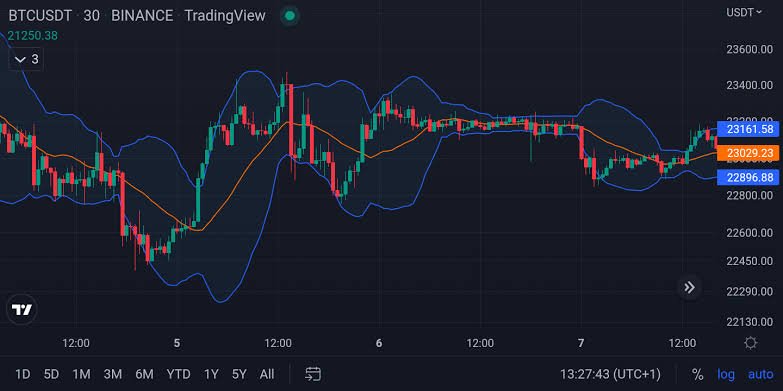
- Candlestick charts display price movement visually over chosen time intervals, commonly 15-minute, 1-hour, or 4-hour windows, shorter frames catch quick moves, longer frames clarify the broader trend context.
- Moving averages smooth out price data to help identify the overall trend direction, filtering out short-term noise.
- Relative Strength Index (RSI) measures whether an asset is potentially overbought or oversold, flagging possible reversal zones before they fully play out.
- MACD (Moving Average Convergence Divergence) and Bollinger Bands help traders read momentum and volatility, identifying when a price move might be gaining or losing strength.
- Volume profiles and on-chain data, like exchange inflow and outflow figures, have become increasingly important in 2026, giving traders visibility into whether large holders are moving coins onto exchanges (often a precursor to selling) or off them.
The Four Main Strategies Active Traders Actually Use
No single strategy works in every market condition, and experienced traders switch between these depending on what the market is doing on any given day.
- Scalping: targeting very small price movements, often fractions of a percent, across dozens of trades per day, entering and exiting within seconds or minutes. Profit per trade is tiny but compounds across many executions; this works best in high-liquidity environments with tight spreads, but it’s mentally exhausting and generally not a good starting point for beginners.
- Range trading: buying near a clear support level and selling near resistance, when an asset bounces predictably between two price boundaries. This works well until the range eventually breaks, which is exactly when range traders can get caught badly wrong-footed.
- Trend trading: identifying an asset moving consistently in one direction and riding that momentum, entering in the direction of the trend rather than trying to predict a reversal.
- Breakout trading: entering a position when price decisively moves beyond an established support or resistance level, on the theory that a genuine breakout tends to accelerate rather than immediately reverse.
- Arbitrage: exploiting small pricing gaps for the same asset across different exchanges, buying low on one platform and simultaneously selling higher on another, a strategy increasingly executed by bots given how quickly these gaps close.
What a Typical Day Trading Session Actually Looks Like
A structured approach separates traders who last from those who blow up their account within weeks.
- Analyze multiple assets simultaneously, screening for the most promising opportunities based on volatility, trading volume, and clear technical setups rather than fixating on a single coin.
- Set specific entry prices in advance for where you’ll open a position, rather than reacting emotionally to price movement in real time.
- Define exit points before entering the trade, both a profit target and a stop-loss level, so the trade’s risk and reward are decided with a clear head, not adjusted mid-trade under emotional pressure.
- Use platforms offering real-time data with minimal latency, advanced charting, and order types beyond basic market and limit orders, including stop-loss, take-profit, and trailing stop orders that automatically manage risk even when you’re not actively watching the screen.
Risk Management — The Part That Actually Determines Survival
Professionals are consistent on this point: risk management matters more than any single indicator or trading setup.
- Trade only with genuine risk capital, money that, if lost entirely, would not affect your financial security or daily life.
- Risk no more than 1-2% of your total account balance on any single trade, this single rule is what prevents a string of losses from wiping out an entire account.
- A commonly cited framework is the “3-5-7 rule”: risking roughly 3% on a single trade, capping daily drawdown at around 5%, and targeting about 7% net gain before stepping away, exact numbers vary by source, but the underlying discipline of hard, predefined limits is the consistent principle.
- Fees compound meaningfully at high trading frequency, exchanges typically charge separate maker and taker fees, and for traders executing dozens of trades monthly, even a 0.01% difference in fee structure can materially affect overall profitability.
- Emotional decision-making is the single most common reason traders fail, chasing a loss with a bigger, riskier trade, or exiting a winning position too early out of fear, consistently erodes returns more than any bad technical read.
The Honest Reality About Profitability
It’s worth being genuinely direct about the odds here rather than presenting day trading as an easy path to income.
- Most people who try day trading crypto lose money, and those who do succeed generally treat it as a skill requiring months, sometimes years, of deliberate practice to develop, not something picked up casually over a weekend.
- Income from day trading is inherently inconsistent, since it depends entirely on volatility and market structure that varies day to day; there’s no dependable daily payout built into the market, regardless of how disciplined your risk management is.
- Roughly 40% of crypto day traders quit within their first three months, largely because they rely on chasing patterns rather than building a genuinely repeatable, tested strategy.
- A daily profit target can help with discipline, but it’s a personal benchmark, not a promise the market is obligated to deliver.
The India-Specific Reality Worth Understanding
Day trading crypto in India carries a genuinely important tax consideration that makes the strategy considerably harder to execute profitably than in many other markets.
- Every profitable trade is taxed at a flat 30%, regardless of how small the gain or how many trades you execute in a day, there’s no reduced rate for high-frequency activity.
- A 1% TDS applies on transaction value once annual thresholds are crossed, meaning liquidity gets withheld on nearly every trade a frequent day trader makes, a genuine cash-flow drag beyond just the eventual tax liability.
- Losses cannot offset gains from other trades, since each transaction is taxed in isolation under Indian law, a day trader who has five winning trades and three losing trades in a session still pays full 30% tax on the winners, with zero relief from the losses.
- This combination makes high-frequency day trading in India structurally more expensive than in jurisdictions with more conventional capital gains treatment, a factor worth weighing seriously before committing to an active trading strategy specifically from India.
The Bottom Line
Cryptocurrency day trading works by opening and closing positions within a single session, using technical indicators, candlestick patterns, moving averages, RSI, and volume data, to capture small, repeatable price movements rather than betting on long-term project growth. The strategies themselves, scalping, range trading, trend following, and breakout trading, are well established and genuinely used by active traders, but the discipline required to manage risk, control emotion, and survive an unforgiving 24/7 market is what actually separates the roughly 40% who quit within three months from the minority who build this into a sustainable skill. This is general educational information, not financial or trading advice; day trading carries genuine, significant risk of loss, and anyone considering it, particularly from India given the added tax burden on frequent trading, should consult a qualified financial adviser and trade only with capital they can genuinely afford to lose.
Frequently Asked Questions
Q1. Is day trading cryptocurrency actually a reliable way to earn consistent income?
A: No, genuinely, income from day trading is inherently inconsistent because it depends entirely on market volatility, which varies unpredictably day to day, and most people who attempt it lose money, with roughly 40% quitting within their first three months due to relying on pattern-chasing rather than a tested, disciplined strategy.
Q2. Which day trading strategy is considered the safest starting point for beginners?
A: Scalping is generally considered the least beginner-friendly since it’s mentally exhausting and demands extremely fast execution, while range trading and trend trading tend to be more approachable starting points, though experienced traders consistently recommend building risk management discipline before focusing heavily on any specific strategy at all.
Q3. Why is day trading crypto specifically more expensive from a tax perspective in India compared to other countries?
A: India taxes every profitable crypto transaction at a flat 30% with no reduced rate for frequency, applies a 1% TDS on transaction value once thresholds are crossed, and doesn’t allow losses to offset gains from other trades, meaning a day trader with several winning and losing trades in one session still owes full tax on every winning trade individually.
Q4. How much of my account should I risk on a single day trade to avoid losing everything?
A: Most professionals recommend risking no more than 1-2% of your total account balance on any single trade, a discipline specifically designed to ensure that even a string of consecutive losses doesn’t wipe out your entire trading account.