Some markets are famous for what they sell. Anjuna is famous for what it represents — a spirit of open-ended wandering, accidental discovery, and the particular pleasure of browsing through stalls set up on a sandy field next to the Arabian Sea with the sound of waves competing with the sound of vendors calling out prices. The Anjuna Flea Market began in the 1960s and 1970s as a gathering point for the global hippie community that had discovered Goa as a counter-cultural haven. What started as travellers exchanging handmade goods, second-hand clothing, and handcrafted items to sustain a beach lifestyle has evolved into one of India’s most iconic weekly markets — and despite that evolution, the Wednesday market at Anjuna still carries more of its original character than most such places manage to retain.
Quick Overview: Anjuna Flea Market Goa
| Detail | Information |
| Location | Monteiro Vaddo, Anjuna Beach Road, Anjuna, North Goa – 403509 |
| Distance from Panaji | ~18 km |
| Market Type | Open-air weekly flea market |
| Market Day | Every Wednesday only |
| Timings | 8:00 AM – 6:00 PM (some sources cite 9:00 AM – 7:00 PM) |
| Season | October to April (closed May to September) |
| Entry Fee | Free |
| Known For | Bohemian fashion, handicrafts, jewellery, spices, Goan souvenirs, beachside atmosphere |
| Nearest Airport | Manohar International Airport (GOX), ~40 km; Dabolim (GOI), ~45 km |
| Parking | Available near the market field; scooter recommended for approach |
Where Exactly Is Anjuna Flea Market
The market is located at Monteiro Vaddo, Anjuna Beach Road, Anjuna, North Goa 403509. Anjuna itself is about 18 km from the state capital Panaji and sits along North Goa’s coastline between Vagator to the north and Baga to the south. The market occupies a large open sandy field that extends toward the beach, with stalls arranged across the field and spilling into the surrounding lanes of the village. From the market edge, Anjuna Beach is a short walk.
Getting here by scooter or motorbike is the most practical option within Goa — rental scooters are widely available across North Goa and getting to Anjuna by road takes 20 to 40 minutes from Baga, Calangute, or Vagator depending on traffic. By bus, the options require a change at Mapusa or Panaji followed by a local bus to the Anjuna bus stop, from which the market is a few minutes on foot. Boat access from Baga Beach is possible and adds a scenic dimension but costs considerably more. There is no direct bus connection from either airport to Anjuna — airport taxis or cabs are the standard arrival option.
The market is seasonal and strictly Wednesday-only. This is the single most important logistical fact for planning: visiting Goa specifically to see the Anjuna Flea Market requires aligning the itinerary with a Wednesday between late October and early April. The market does not operate during the monsoon months from May to September.
What Shops You Will Find
The stall range at Anjuna reflects its layered history — original craft sellers alongside commercial vendors who have set up to meet tourist demand, and the two tracks coexist without too much friction.
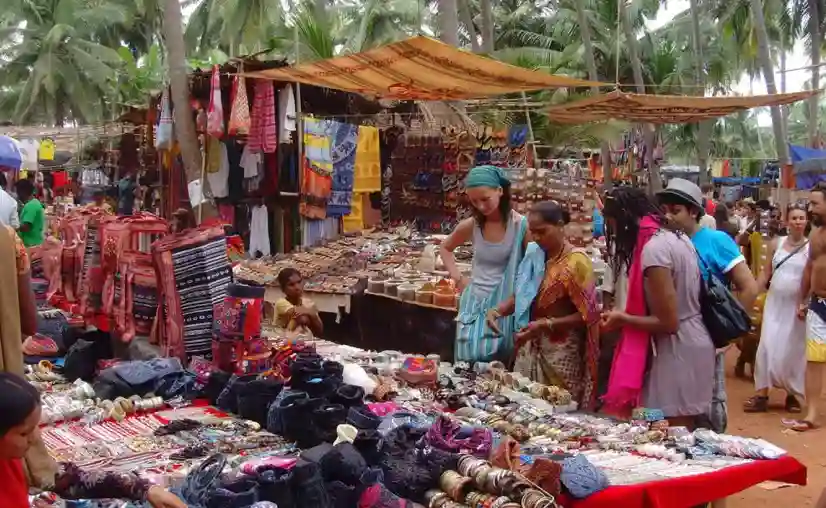
Bohemian clothing is the most visible category. Printed kaftans, cotton dresses, sarongs, harem pants, embroidered kurtas, tie-dye tops, and beach-ready linen shirts fill dozens of stalls run by vendors from Rajasthan, Kashmir, and Karnataka who migrate to Goa for the season. Prices are negotiable and the range is genuinely broad — from five-rupee trinkets to elaborately hand-embroidered jackets.
Jewellery is extensive. Silver pieces with semi-precious stones, bead necklaces, oxidised metal earrings, ankle chains, and handcrafted rings from artisans who make them at the stall or nearby workshops are common. Rajasthani silver work and Kashmiri stones appear regularly. Handcrafted leather goods — sandals, bags, belts, and journal covers — are a dedicated section.
Spices, incense, essential oils, and herbal products from Goa and Kerala are sold by vendors who travel with bulk supply each week. Goan cashews, feni (Goan spirit), preserved foods, and locally made sauces appear at certain stalls. Handicrafts covering pottery, wooden carvings, dreamcatchers, macramé, and wall art fill the remaining space. Antique-style items, vintage clothing, and secondhand goods from foreign visitors who sell before leaving Goa add an unpredictable treasure-hunt dimension to the browsing.
Food at the Market
Food stalls run along the perimeter and through the market lanes, handling everything from Goan seafood — fish curry, prawn fry, crab preparations — to North Indian, Chinese, and continental options catering to the tourist crowd. Fresh coconut water, sugarcane juice, and cold drinks are available throughout. Some stalls run proper small kitchens; others are simpler setups. Eating at the market is part of the experience — budget for a meal here rather than eating before arriving.
Nearby Areas Worth Visiting
Anjuna Beach is immediately adjacent — white sand, rock formations at the southern end, and the relatively laid-back character of a North Goa beach that has not been completely taken over by party infrastructure. Vagator Beach and the Little Vagator viewpoint are about 3 km north. Chapora Fort, a Portuguese ruin on a hill overlooking the sea made famous by the film Dil Chahta Hai, is roughly 4 km away. Mapusa Market — Goa’s largest local market, held every Friday — is about 10 km from Anjuna and worth combining with the trip for a more everyday Goan market experience.
FAQs
Q1. What day does the Anjuna Flea Market operate?
The Anjuna Flea Market runs every Wednesday only, from approximately 8:00 AM to 6:00 PM. It operates seasonally from late October to early April and remains closed during the monsoon months of May to September.
Q2. What is Anjuna Flea Market famous for?
It is best known as Goa’s most iconic open-air flea market — bohemian clothing, handcrafted jewellery, leather goods, Goan spices, handicrafts, and the unique beachside atmosphere that traces back to the hippie community gatherings of the 1960s and 1970s.
Q3. How do I reach Anjuna Flea Market?
Renting a scooter or motorbike within Goa is the most practical option. By bus, change at Mapusa or Panaji for a local service to Anjuna. Direct cabs from anywhere in North Goa take 20 to 40 minutes. There is no direct public transport connection from the airports.
Q4. Is entry to Anjuna Flea Market free?
Yes. There is no entry fee. The market is open-access and free to walk through.
Q5. What is the best time to arrive at Anjuna Flea Market?
Early morning — around 8:00 AM to 10:00 AM — offers the freshest stock, lighter crowds, and better negotiating conditions. Peak hours between 11:00 AM and 3:00 PM are the busiest. Late afternoon from around 4:00 PM onwards sees vendors willing to negotiate more aggressively as they pack up for the day.