The name translates literally as “saltwater stepwell” — a description of the saline baoli that once existed here when this was the western edge of the Mughal city. The stepwell is gone. What replaced it, and has grown for nearly four hundred years on the same streets, is something remarkable: Asia’s largest wholesale spice market, a commercial institution that has survived Mughal decline, British rule, Partition, and the rise of organised retail without losing the essential character that makes it irreplaceable. Some of the shops in Khari Baoli are run by the tenth, eleventh, or even twelfth generation of the same family that opened them. The heaped sacks of Kashmiri red chilies, the towers of cardamom pods, the mounds of turmeric that turn the air yellow — none of this has changed because none of it needs to.
The market was established around 1650 under the reign of Shah Jahan, adjacent to the Fatehpuri Masjid at the western end of the Chandni Chowk axis. Fatehpuri Begum — one of Shah Jahan’s wives — is credited with commissioning the mosque and the commercial zone that grew alongside it. The spice trade consolidated here because this was the westernmost commercial point of Shahjahanabad, where caravans from Punjab, Rajputana, and the northwest frontier arrived with their cargo before the goods moved deeper into the city.
Quick Overview: Khari Baoli Market Delhi
| Detail | Information |
| Location | Khari Baoli Road, near Fatehpuri Masjid, Old Delhi (Chandni Chowk) – 110006 |
| Established | c. 1650 CE (Mughal era, Shah Jahan) |
| Area | Old Delhi / Chandni Chowk |
| Market Type | Asia’s largest wholesale spice market |
| Timings | 11:00 AM – 7:00 PM (Monday to Saturday); some variation |
| Weekly Off | Sunday |
| Entry Fee | None |
| Nearest Metro | Chandni Chowk Station, Yellow Line (~10–15 min walk, Exit Gate 1 or 5) |
| Also Near | Chawri Bazar Station, Yellow Line (~1 km) |
| Known For | Wholesale spices (red chilli, turmeric, cardamom, black pepper, saffron), dry fruits, nuts, herbs, tea, grains, pulses, Afghan imports |
Where Exactly Is Khari Baoli Market
Khari Baoli is located on Khari Baoli Road, adjacent to the Fatehpuri Masjid, in the Chandni Chowk neighbourhood of Old Delhi, pin code 110006. The market is positioned at the western terminus of the Chandni Chowk commercial axis — if you walk the full length of Chandni Chowk from the Red Fort westward, Khari Baoli begins as you approach the Fatehpuri Masjid at the street’s far end. From Chandni Chowk Main Road, turning right at Fatehpuri Masjid leads directly into the market’s lane network.
Chandni Chowk Metro Station on the Yellow Line is the most convenient transit access — approximately 10 to 15 minutes on foot from the market’s start, exiting from Gate 1 or Gate 5. Cycle-rickshaws from the metro station to Khari Baoli are available and cover the distance in a few minutes. Chawri Bazar Station is approximately 1 km away. DTC buses on Routes 103, 116, 107, 131, 205, 405, 112, 113, and 17 all serve the area, with the Old Delhi Railway Station and Peeli Kothi stops both within a 5-minute journey. Old Delhi Railway Station connects the market to the broader railway network for out-of-city buyers.
What Shops You Will Find
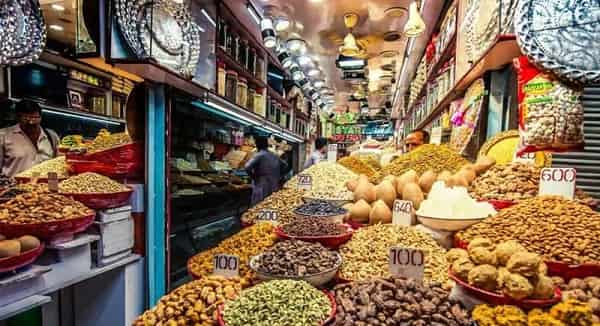
Spices are the overwhelming primary category, with a variety that photographs compellingly and overwhelms the nose within minutes of entering the lanes. Kashmiri red chilies — the large, deep-red, moderately hot variety prized for colour rather than heat in North Indian cooking — arrive in 50 kg sacks and are available by the kilogram for retail buyers. Turmeric in root and powder form, cardamom both green and black, cumin, coriander, black pepper, fennel, cloves, cinnamon, star anise, mace, and nutmeg are the everyday spice inventory. Beyond these, Khari Baoli carries exotic and specialist spices that are difficult to source elsewhere: unrefined pink salt from Rajasthan, black salt (kala namak), saffron from Kashmir, asafoetida (hing) in resinous and powder forms, and the specifically regional spice combinations that characterise different Indian culinary traditions.
Afghan imports occupy their own commercial category — prunes, dried mulberries, dried plums, and the range of dried fruits that arrive through the Afghanistan-Pakistan trade route. These give Khari Baoli an international sourcing dimension that most Indian spice markets lack. Dry fruits and nuts more broadly — cashews, almonds, walnuts, pistachios, raisins, apricots — are available in quantities and at prices that reflect direct wholesale sourcing. Herbs (both culinary and medicinal), tea in multiple varieties, grains, pulses, lentils, khoya (dried milk solids), and jaggery round out the market’s comprehensive food ingredient offering.
The market is wholesale in structure but accessible to retail buyers — no minimum quantity is required for most items, and shopkeepers are accustomed to selling small quantities to individual buyers at prices that reflect a modest premium above the wholesale rate. Some famous shop numbers that have maintained their identities across generations include “Chawal Wale 13”, “21 Number ki Dukaan”, and “15 Number ki Dukaan” — the numbers reflecting original registration identifiers from the market’s organised early phase.
Nearby Areas Worth Visiting
Fatehpuri Masjid at the market’s entrance is a 17th-century Mughal mosque of considerable architectural merit, often bypassed by visitors focused on the market and Chandni Chowk’s better-known sites. The full Chandni Chowk axis — with its specialised lanes for silver (Dariba Kalan), wedding trims (Kinari Bazaar), books (Nai Sarak), and electrical goods (Bhagirath Palace) — is the natural companion circuit. Paranthe Wali Gali for breakfast paranthas and the Old Famous Jalebi Wala for jalebis are within short walking distance as part of the Old Delhi food circuit.
FAQs
Q: What is Khari Baoli Market Delhi famous for?
A: Khari Baoli is Asia’s largest wholesale spice market, established around 1650 during the Mughal era of Shah Jahan, adjacent to the Fatehpuri Masjid in Old Delhi. It is famous for its extraordinary variety of spices, dry fruits, nuts, herbs, teas, grains, and imported goods from Afghanistan, all available at wholesale prices. Some shops have been in the same family for ten or more generations.
Q: What are the timings of Khari Baoli Market?
A: Most shops operate from 11:00 AM to 7:00 PM, Monday through Saturday. Sunday is the weekly off day. Weekday mornings are the least crowded window for comfortable browsing; weekend afternoons are the most congested.
Q: Which metro station is nearest to Khari Baoli Market?
A: Chandni Chowk Metro Station on the Yellow Line is the closest, approximately 10 to 15 minutes on foot from the market entrance (Exit Gate 1 or 5). Chawri Bazar Station on the same line is approximately 1 km away.
Q: Can retail buyers shop at Khari Baoli, or is it only wholesale?
A: Retail buyers are welcome — Khari Baoli serves both wholesale trade buyers and individual shoppers. No minimum quantity is required, though buying slightly larger quantities (a kilogram rather than 100 grams) brings the pricing closer to the wholesale base rate. The market is explicitly described as accessible to individual buyers throughout its reviews and guides.
Q: What makes Khari Baoli unique among Delhi’s markets?
A: Its age — nearly 400 years of continuous operation — and its generational continuity, with some shops run by families in their tenth or twelfth generation at the same address. No other market in Delhi combines this historical depth with active, daily wholesale trade at the scale Khari Baoli operates. The combination of sensory intensity, historical significance, and genuine commercial function makes it one of the most authentic market experiences available in any Indian city.