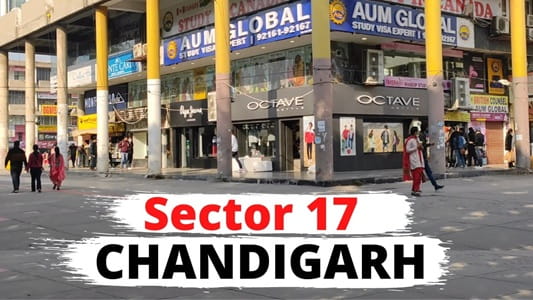
Few Indian markets carry the architectural credentials of Sector 17. The open-air pedestrian plaza at the heart of Chandigarh’s commercial district was designed by Le Corbusier — the Swiss-French architect who planned the entire city from scratch after Partition — as part of his vision for a modern Indian capital. Wide colonnaded walkways, generous pedestrian space, tree-lined avenues, a central fountain, and a deliberate absence of vehicular intrusion: these were not afterthoughts but core design principles. The result is a shopping district that feels physically unlike any other major market in India.
The city itself was designed to replace Lahore as the capital of Punjab after the 1947 Partition, and Le Corbusier’s plan for Chandigarh became one of the most studied exercises in modernist urban planning. Sector 17 was conceived as the commercial and civic centre — the equivalent of what an old bazaar would have been in an organically grown city, but reimagined through the lens of 20th-century European urban design. The plaza still functions broadly as Le Corbusier intended: a walkable, human-scale commercial zone at the city’s centre.
Quick Overview: Sector 17 Market Chandigarh
| Detail | Information |
| Location | Sector 17, Chandigarh – 160017 |
| Designed By | Le Corbusier (part of the planned city of Chandigarh) |
| Area | Central Chandigarh |
| Market Type | Planned open-air pedestrian commercial plaza |
| Timings | 10:00 AM – 10:00 PM (Monday to Saturday; many shops open Sunday) |
| Weekly Off | Most shops observe Tuesday or Wednesday as weekly off |
| Nearest Bus Stop | Sector 17 Bus Terminus (ISBT Sector 17) |
| Known For | Branded retail, Phulkari handicrafts, books, jewellery, Punjabi cuisine, Le Corbusier architecture |
| Parking | Ample; multi-level parking available near the plaza |
Where Exactly Is Sector 17 Market
Sector 17 Market is located in Sector 17, Chandigarh 160017 — the geographic centre of the city, as planned. The Sector 17 Bus Terminus (ISBT) is immediately adjacent, connecting the market to all parts of Chandigarh, Mohali, Panchkula, and the broader Punjab and Haryana region. Chandigarh does not yet have a metro system, but the bus network — operated by CTU (Chandigarh Transport Undertaking) — is extensive, with Sector 17 functioning as the primary hub from which most city routes radiate.
By road, Sector 17 is accessible from the main inter-sector roads that divide Chandigarh’s grid-planned layout. Parking is available in multi-level facilities near the plaza, more generous than most Indian commercial markets. The airport is approximately 11 km away. For visitors coming from Delhi, the road journey via NH-44 takes approximately 4 to 4.5 hours.
The market’s pedestrian design means that once inside the plaza area, everything is navigable on foot — a genuinely unusual feature among Indian commercial markets of this size and variety.
What Shops You Will Find
The branded retail presence at Sector 17 is among the strongest of any Indian city outside the major metros. International names including Zara, H&M, Adidas, Nike, and Levi’s operate alongside established Indian retail chains. Woodland, Fabindia, Archies, and similar lifestyle brands have long-standing stores here. The concentration of branded fashion, footwear, and lifestyle retail reflects Chandigarh’s high per-capita income and the affluent profile of Punjab’s urban consumer.
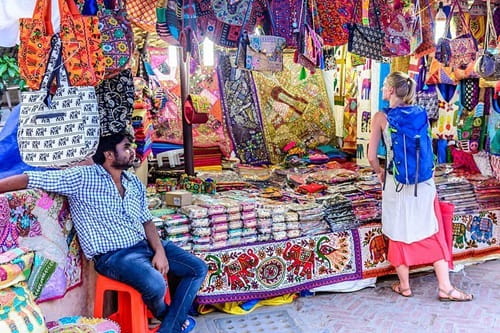
Local boutiques and traditional retail run parallel to the branded names. Phulkari — Punjab’s celebrated embroidery tradition — has dedicated shops including the Punjab Government Emporium (which stocks authentic state handicrafts alongside Phulkari). Bridal wear, Punjabi suits, and ethnic fashion from local boutiques occupy significant commercial space in the sub-sectors of the plaza.
Books and stationery have traditionally had a strong presence in Sector 17, reflecting Chandigarh’s educated residential demographic. Electronics shops, jewellers — particularly gold and diamond jewellery in Punjabi bridal styles — optical outlets, and home décor stores round out the offering across the plaza’s multiple sub-sectors (17A through 17F).
The market has faced structural challenges in recent years — a notable building collapse in January 2025 that once housed the Mehfil Restaurant has prompted scrutiny of older structures in the plaza. The broader market continues to operate normally across the rest of its area.
Food at Sector 17
Punjabi food is the dominant register. Dhabas and restaurants serving dal makhani, butter chicken, paranthas, and lassi are spread across the market and its immediate surroundings. The market has formal restaurant chains alongside street food counters — ice cream parlours, chaat stalls, and fast food outlets running along the colonnaded walkways that make eating outdoors genuinely pleasant in the evenings. The winter months — October through February — are when evening eating around the fountain and plaza is most popular, when Chandigarh’s cold but dry air makes outdoor seating at food counters something locals actively seek out.
Nearby Areas Worth Visiting
Chandigarh’s famous landmarks are all within short distance from Sector 17. Rock Garden — Nek Chand’s extraordinary outsider art installation built from industrial and urban waste — is about 3 km away and represents one of India’s most unusual and compelling creative environments. The Rose Garden (Zakir Hussain Rose Garden) is among Asia’s largest rose gardens, within easy reach. Sukhna Lake, a man-made reservoir at the foot of the Shivalik Hills, is popular for morning walks and evening boat rides, approximately 4 km from the market. The Capitol Complex — the government buildings designed by Le Corbusier, which are a UNESCO World Heritage Site — is about 4 km away.
FAQs
Q1. What is Sector 17 Market Chandigarh famous for?
Sector 17 is Chandigarh’s primary commercial and cultural hub, designed by Le Corbusier as part of the city’s planned layout. It is known for its pedestrian-friendly plaza, branded retail including international fashion labels, Phulkari handicraft shops, jewellery, Punjabi food, and its distinctive modernist colonial architecture.
Q2. What are the timings of Sector 17 Market Chandigarh?
Most shops operate from 10:00 AM to 10:00 PM, Monday through Saturday. Many shops also remain open on Sundays. Individual shops may observe Tuesday or Wednesday as a weekly off — checking specific stores in advance is advisable.
Q3. How do I reach Sector 17 Market Chandigarh?
The Sector 17 Bus Terminus (ISBT Sector 17) is immediately adjacent — most CTU city routes and many Punjab Roadways services terminate here. By auto-rickshaw from the railway station, the journey takes approximately 15 minutes. Chandigarh does not have a metro; buses and autos are the primary public transit options.
Q4. Is Sector 17 good for handicraft and traditional Punjabi shopping?
Yes. The Punjab Government Emporium in Sector 17 stocks authentic Phulkari embroidery, Punjabi handicrafts, and traditional items at fixed government prices. Several private boutiques also carry Punjabi ethnic wear, bridal suits, and local craft items alongside the branded retail.
Q5. What is the best time to visit Sector 17 Market?
October through March — the cooler months — offer the most pleasant experience, particularly evenings when the wide walkways and central fountain area come alive. Summers (April–June) can be very hot during the day; morning visits before 11:00 AM and post-sunset evenings work better in warm months.